
The first groups of Amur falcons have arrived in Tamenglong district, while two satellite-tagged birds tracked from China are expected to reach Manipur later this month.
Imphal, Manipur: The annual arrival of Amur falcons in Manipur has begun, signalling the onset of one of the world’s most remarkable avian migration events. Residents of Guangram village in Tamenglong district reported the first sightings of the migratory birds on October 11, indicating the start of the seasonal movement through the region.
Forest officials confirmed that small flocks have already reached their traditional roosting areas in the district. The birds are expected to continue arriving in larger numbers over the coming weeks before remaining in the region until late November.
Tamenglong Divisional Forest Officer Amit Kelar said the migration season had commenced with the arrival of the first batches of falcons. Guangram, where the birds were initially spotted this year, lies nearly 150 kilometres west of Imphal and is among the important locations frequented by the species during its annual stopover.
Known for undertaking one of the longest migratory journeys among birds of prey, Amur falcons travel thousands of kilometres each year between their breeding grounds in East Asia and their winter habitats in southern Africa. The raptors make a crucial halt in India’s Northeast, particularly in Manipur and Nagaland, before crossing vast stretches of the Indian Ocean on their southward journey.
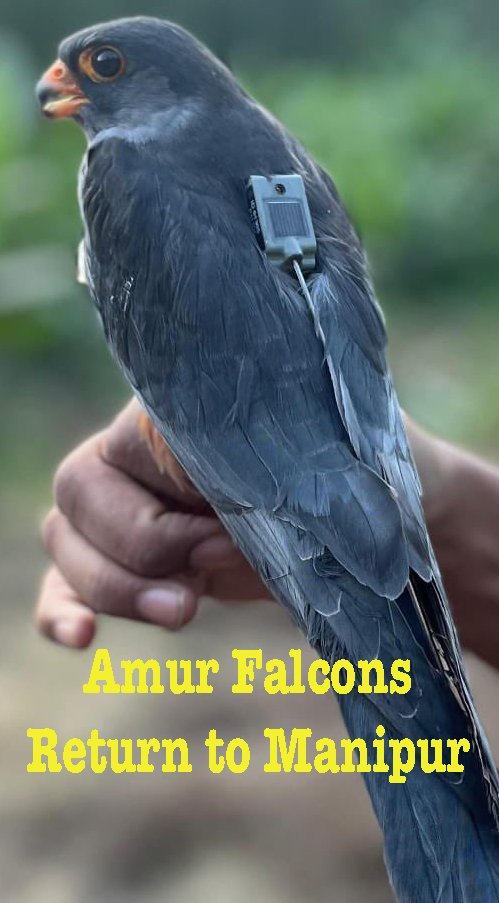
Wildlife researchers are also closely monitoring the movement of two satellite-tagged Amur falcons, Apapang and Alang, which began their migration from northeastern China on October 10. According to scientists tracking the birds, the pair are likely to reach Manipur around October 20.
The tagged birds derive their names from local geographical landmarks in Tamenglong district, reflecting the region’s long association with the species and its conservation efforts. Data collected from satellite transmitters has helped researchers better understand migration routes, stopover sites and environmental conditions encountered by the birds during their transcontinental journey.
Manipur’s satellite-tagging initiative, launched in 2018, has emerged as an important scientific programme for studying the species. The project has involved collaboration among the Wildlife Institute of India, the state Forest Department, district authorities, conservation groups and local communities. Earlier tagging exercises carried out in Tamenglong provided valuable insights into the falcons’ migration patterns and habitat use.
Over the past decade, conservation efforts led by village communities, government agencies and environmental organisations have transformed the region into a model for community-based wildlife protection. Awareness campaigns, habitat protection measures and the annual Amur Falcon Festival have played a key role in encouraging local participation in safeguarding the birds during their stay.
The species enjoys legal protection under India’s wildlife laws, while international conservation agreements also recognise the need for coordinated action to protect migratory birds across national boundaries.
Earlier this year, Union Environment, Forest and Climate Change Minister Bhupender Yadav highlighted Manipur’s Amur falcon conservation programme as a notable example of successful community-led wildlife protection, underscoring the role of local residents in ensuring the safe passage of the migratory raptors through the state.
As more falcons continue to arrive in the coming days, Tamenglong’s skies are once again expected to witness the spectacular seasonal gathering that has become synonymous with conservation success in Northeast India.