
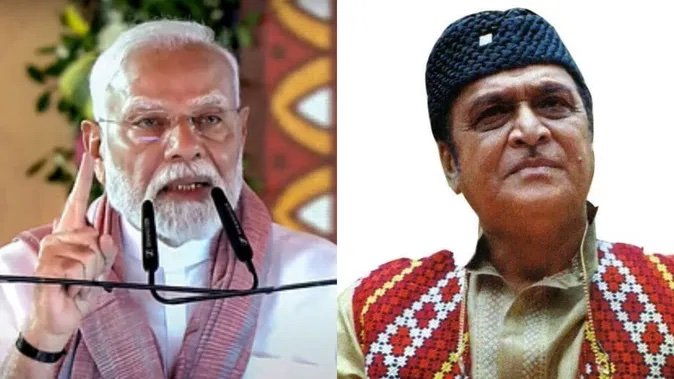
Prime Minister Narendra Modi on Monday paid heartfelt tribute to legendary musician and cultural icon Bhupen Hazarika on his 99th birth anniversary, describing him as “one of the most extraordinary voices India has ever known.”
In a personal article shared on social media, the Prime Minister reflected on Hazarika’s enduring legacy and announced the beginning of year-long centenary celebrations to honour the Bharat Ratna awardee. Modi said the occasion was an opportunity to revisit Hazarika’s contributions to India’s cultural identity and social consciousness.
“What Bhupen Da gave us extends far beyond music. His works embodied emotions that transcended melody. More than just a voice, he was the heartbeat of the people,” Modi wrote, adding that generations have grown up listening to his songs, which carried messages of compassion, justice, and belonging.
Born in Assam’s Sadiya in 1926, Hazarika’s artistic journey spanned continents, yet he remained deeply rooted in the ethos of his native state. Modi recalled Hazarika’s academic excellence at Cotton College, Banaras Hindu University, and Columbia University, where he interacted with global intellectuals and artists. It was during his time in the United States that he met civil rights activist Paul Robeson, whose song “Ol’ Man River” inspired Hazarika’s iconic Assamese composition “Bistirna Parore.”
Hazarika was also honoured with a Gold Medal by former U.S. First Lady Eleanor Roosevelt for his performances of Indian folk music, the Prime Minister noted.
Despite opportunities abroad, Hazarika chose to return to India, immersing himself in radio, theatre, cinema, and documentary filmmaking. Modi praised his ability to blend lyrical artistry with powerful social messages, addressing themes such as rural development, equality, and the strength of ordinary citizens.
“The spirit of Ek Bharat, Shreshtha Bharat found powerful expression in Bhupen Hazarika’s life journey,” Modi said, highlighting the artist’s work across Assamese, Bengali, and Hindi cinema, which helped bring Assam’s culture to national and international audiences.
Modi also recalled Hazarika’s brief stint in politics, noting that he was elected as an independent MLA in 1967 but chose not to pursue a political career, dedicating himself instead to cultural service.
The Prime Minister reflected on the emotional farewell Hazarika received upon his death in 2011, when lakhs of admirers gathered for his funeral. “Even in death, as in life, he brought people together,” Modi wrote, calling it fitting that Hazarika was cremated at Jalukbari hillock overlooking the Brahmaputra — the river that inspired much of his music.
Modi welcomed efforts by the Assam government and the Bhupen Hazarika Cultural Trust to preserve and promote the artist’s legacy, especially among younger generations. “Bhupen Da’s life teaches us the power of empathy, of listening to people, and of staying rooted,” he concluded.