
Guwahati, Assam: The Assam Cabinet on Friday adopted a set of 75 resolutions outlining key developments witnessed in the state during Prime Minister Narendra Modi’s 25-year journey in public office, crediting a range of initiatives for accelerating Assam’s economic, social and infrastructural progress.
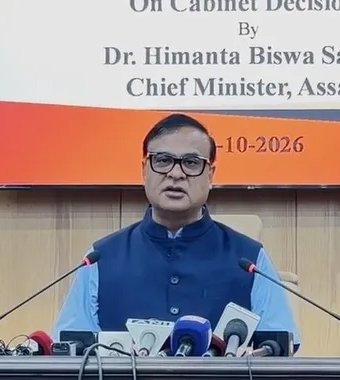
The resolutions were approved during a special 90-minute Cabinet meeting chaired by Chief Minister Himanta Biswa Sarma. The meeting was convened to reflect on the transformation witnessed in Assam and the Northeast during the period spanning Modi’s tenure as Gujarat Chief Minister and later as Prime Minister.
Briefing reporters after the meeting, Sarma said the state had undergone substantial changes over the past decade, with gains visible across sectors such as connectivity, investment, healthcare, education and public infrastructure. He noted that a more stable security environment had helped create the foundation for growth, while improved transport links and policy support had encouraged investment and economic activity.
According to the resolutions, Assam’s progress has not been limited to economic indicators alone. The document points to advances in social development, expansion of public infrastructure, strengthening of institutions and enhanced strategic relevance of the state in the national context.
The Cabinet observed that Assam has steadily shed its image as a geographically distant frontier and is now emerging as a key growth centre in the Northeast, attracting investments while strengthening its role in India’s engagement with neighbouring countries in Southeast Asia.
Several marquee projects were highlighted during the deliberations, including the semiconductor facility proposed at Jagiroad, the expansion of Numaligarh Refinery and a series of major road and transport initiatives aimed at improving regional connectivity. Infrastructure projects such as the Guwahati Ring Road, the proposed Gohpur-Numaligarh tunnel and other strategic corridors also found mention in the resolution.
The document further referred to industrial and energy-sector investments, including the Namrup-IV fertiliser plant, the biofuel project at Numaligarh and the Barauni-Guwahati gas pipeline. It also noted the large-scale investment commitments announced during the Advantage Assam summit, which reflected growing investor interest in the state.
On the peace front, the Cabinet acknowledged various agreements signed with insurgent and ethnic groups over the years, describing them as important milestones in the efforts to bring lasting stability to the region. Improved peace and security, it noted, have played a significant role in creating an environment conducive to development.
The resolutions also highlighted the strengthening of healthcare and higher education infrastructure through the establishment and expansion of premier institutions, alongside growing recognition of Assam’s cultural and historical heritage. References were made to international recognition accorded to the Charaideo Moidams and the conferment of Classical Language status on Assamese.
The Cabinet further noted that Prime Minister Modi has visited Assam on numerous occasions since assuming office, underscoring the importance accorded to the state in the Centre’s development agenda. It stated that Assam is increasingly positioning itself as a vital economic and strategic bridge between mainland India and the broader Southeast Asian region under the Act East framework.
The resolutions collectively portray Assam’s recent development journey as part of a broader effort to strengthen the Northeast’s integration with national growth priorities while enhancing the state’s role in the vision of a developed India.