

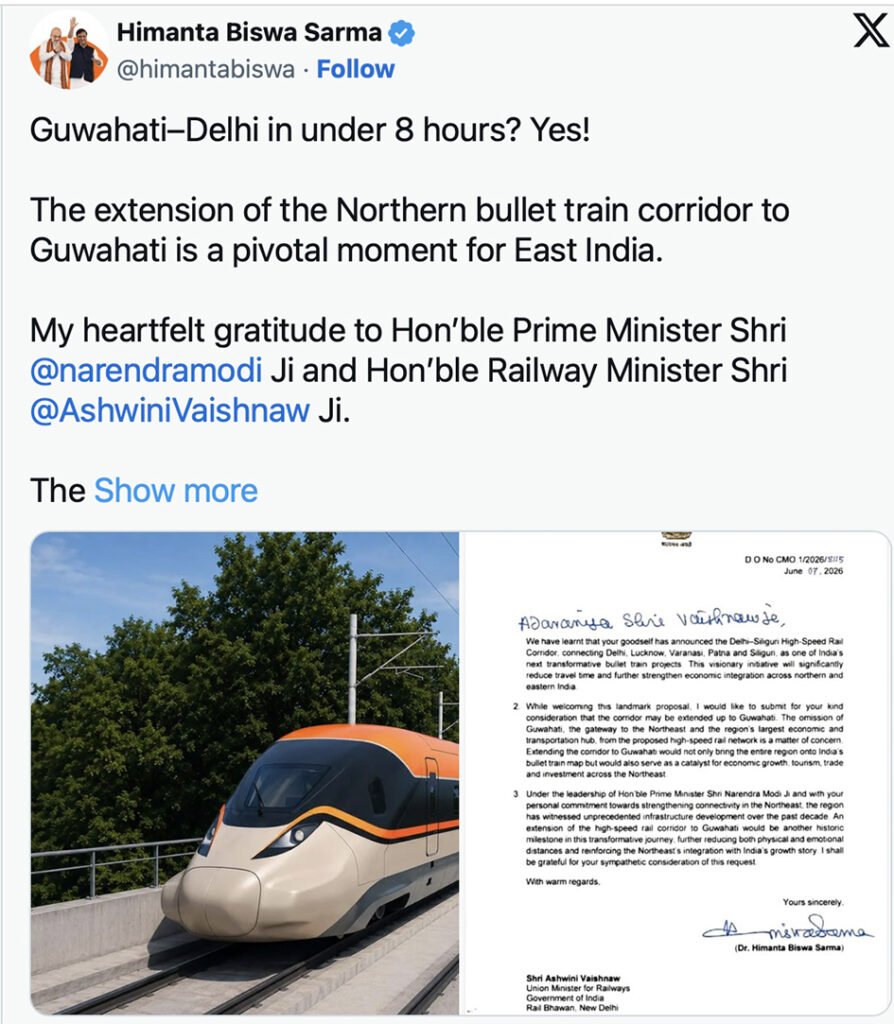
The proposed high-speed rail corridor, approved under India’s northern bullet train network, is expected to connect Delhi with Guwahati through key cities in Uttar Pradesh, Bihar and West Bengal, significantly reducing travel time and boosting connectivity across eastern and northeastern India.
Guwahati, Assam: The Centre has approved a proposed high-speed rail corridor connecting Delhi and Guwahati, marking a major step in the expansion of India’s bullet train network towards the Northeast. Railway Minister Ashwini Vaishnaw announced that the project has received approval as part of the northern bullet train corridor, which is planned to link several major cities across northern and eastern India.
Speaking during the inauguration of a new Vande Bharat Sleeper service between Varanasi and New Delhi, Vaishnaw said the proposed corridor would provide faster and more accessible travel options for a wider section of society. He maintained that high-speed rail services are being envisioned as an affordable mode of transport rather than an exclusive premium offering.
According to details shared by the Railway Minister, the corridor is expected to pass through major urban centres including Agra, Kanpur, Lucknow, Varanasi, Patna and Siliguri before reaching Guwahati. Other reports on the proposed alignment have also indicated connectivity through cities such as Ayodhya and Prayagraj, further strengthening regional integration
The proposed high-speed network is expected to substantially cut travel times between major destinations. Railway authorities have indicated that journeys such as Delhi-Agra, Delhi-Kanpur and Delhi-Lucknow could be completed in under three hours, while travel between Delhi and Varanasi may be reduced to around three-and-a-half hours.
The announcement has been welcomed in Assam, where Chief Minister Himanta Biswa Sarma described the extension of the corridor to Guwahati as a significant breakthrough for the Northeast. He said the project could reduce travel time between Guwahati and the national capital to under eight hours, bringing the region closer to major economic centres of the country
Sarma stated that the original proposal had envisaged the corridor ending at Siliguri, but the route was subsequently extended to Guwahati. He said improved connectivity would support trade, investment and industrial growth in the region, particularly as Assam seeks to attract emerging industries and technology-driven businesses.
The railway minister also underlined that the project would be developed in line with the government’s “Make in India” initiative, with significant participation from domestic engineers and workers. He described the corridor as a long-term infrastructure investment aimed at transforming mobility and regional connectivity for future generations
While the project has been approved in principle, detailed timelines for construction and completion of the Delhi-Guwahati bullet train corridor are yet to be announced.