
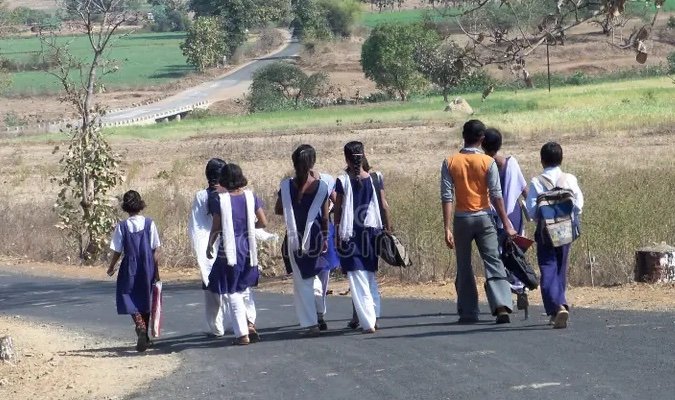
As India celebrates Children’s Day on November 14, commemorating the birth anniversary of Jawaharlal Nehru and his affection for children, the occasion invites a question that goes beyond the celebrations in our schools: Are we ensuring that every child has a school to attend? For a child in a remote village, a school is not merely a building. It may be the only affordable bridge between poverty and opportunity. When that school disappears, the journey to education becomes longer, costlier and sometimes impossible. The NITI Aayog report (May 2026) on India’s school education system raises precisely this concern, challenging us to look beyond the administrative language of ‘rationalisation’ and confront the growing inequality in educational opportunity.
In school education, ‘rationalisation’ means reorganizing the network of schools, often by merging or consolidating small or under-enrolled schools and redeploying teachers and resources with the aim of improving efficiency and educational quality. The concern arises when such reorganisation makes the nearest school too distant for the very children whose access to education depends on it.
The NITI Aayog report states that between 2014-2015 and 2024-2025, the number of government schools fell from 11.07 lakh to 10.13 lakh, while total school enrolment fell by 2.26 crore. The total number of government schools are declined to 94000. What ordinarily happens to the child when the neighbourhood school is merged with another school several kilometres away. The distinction is particularly important for India’s poorest families. A middle-class family may respond to a school closure by arranging private transport or paying fees at a private school. A landless labourer, tribal family or poor rural household often cannot. A longer journey may mean additional transport costs, loss of a parent’s working time, concerns about safety and, for adolescent girls, a decision to discontinue education altogether. The numbers tell us that the problem is not confined to access to the first years of schooling. Nationally, the Gross Enrolment Ratio (GER) is 90.9% at the primary level and 90.3% at upper primary, but falls to 78.7% at secondary and to just 58.4% at higher secondary. Nearly four in ten children do not continue through to higher secondary education.
The problem becomes particularly serious in the Northeast region. The report itself notes that difficult terrain, long distances, poor roads and irregular transport in the Northeast States make regular attendance and teacher deployment difficult. The State of Assam has made progress in a few indicators, but serious gaps remain. Its higher-secondary Gross Enrolment Ratio (GER) is only 43.5%, among the lowest in the country. Its secondary-school dropout rate is 17.5%, one of the highest. The GER for girls at the higher-secondary level is only 47.4%. Meghalaya’s higher-secondary GER is 39.7%, Nagaland’s 39.8%, Arunachal Pradesh’s 43.7% and Assam’s 43.5%. For girls at higher secondary level, Nagaland, Arunachal Pradesh, Meghalaya and Assam remain among the States with deficient participation.
Moreover, the challenge is not simply whether a school exists, it is what happens inside it. India has made considerable progress in school infrastructure. Yet according to UDISE+ of 2024-2025, around 1.19 lakh schools still lacked functional electricity, 59,829 schools lacked handwashing facilities, and 98,592 lacked functional girls’ toilets. Only 51.7% government secondary schools had science laboratories. These are not mere administrative statistics. Government schools are disproportionately the schools of poor families, Scheduled Castes, Scheduled Tribes and other disadvantaged communities. Besides, this raises a larger policy: should we be closing schools because they are small, or should we first ask why some schools become unattractive in the first place?
The gaps mentioned above acquire deeper meaning when viewed through the Indian Constitution. Article 46 directs the States to promote the educational and economic interests of weaker sections. The NITI Aayog report notes that children from ST, SC and OBC communities are more vulnerable to dropping out because of economic disadvantage, discrimination and lower parental education. The Right to Education (RTE) Act gave India a historic promise: free and compulsory education for children aged 6-14. However the financial and geographical barriers become more severe precisely after the RTE age group, and the poorer children are most vulnerable to dropping out.
The solution therefore requires three principles: first, no child should lose education because a school is rationalised. Every proposed merger should pass an equity test: distance, transport, safety, girls’ participation, tribal population, disability access and likely dropout impact. Second, rationalisation must be accompanied by investment. If children are moved to a larger school, that school must have enough teachers, classrooms, laboratories, drinking water, digital facilities and learning support. Composite schools and school complexes can work, but only when accompanied by safe transport and residential support. Thirdly, the communities must have a voice. School Management Committees cannot remain bodies that merely sign documents. Parents, teachers, panchayats, local organizations and community representatives should participate meaningfully in decisions about school mergers and development plans.
The Government cannot carry this enormous responsibility alone. Civil society organizations, philanthropic and faith-based institutions can contribute through hostels for rural and tribal girls, teacher support, remedial education, counselling, digital learning, scholarships, vocational guidance and community mobilization.
India cannot claim to be preparing for the knowledge economy while the child of a tribal hamlet is losing his/her school because it is considered ‘non-viable’. Nor can the country boast of becoming Vishwa Guru while a poor girl must abandon education because the nearest secondary school is too far away. A school is not merely a building. For a poor child, it is a bridge out of poverty, discrimination and exclusion.
As India celebrates Children’s Day, the occasion must become more than a ritual of speeches, cultural programs and expressions of affection for children. It must renew our collective commitment to their rights, dignity and future. More than a century ago, Swami Vivekananda reminded India that if the poor cannot come to education, education must go to them. That principle remains profoundly relevant.
If Viksit Bharat 2047 is to become a reality, its foundations must be laid in the classrooms of India’s poorest villages. The true tribute to our children on Children’s Day is not merely to celebrate their innocence and potential, but to ensure that no child is denied the opportunity to learn, grow and realise that potential simply because the nearest school has moved beyond reach.
Written by Fr. Prasad Kalaparthy, SDB, Don Bosco – Guwahati
write to us at northeastplus8@gmail.com