
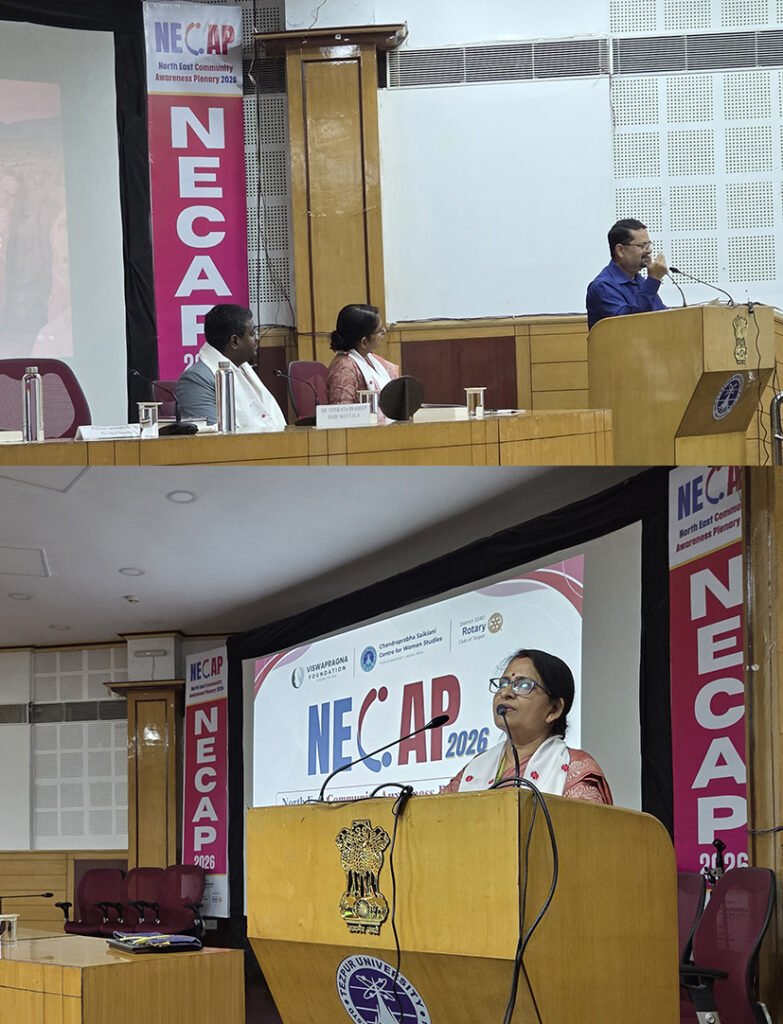
Tezpur, Assam: Ask most families who they turn to with health questions, and the answer is usually a woman. Yet menstruation, cancer screening, vaccination, and genetics are the very subjects that tend to be met with silence or half-truths. On 30 October, the auditorium of Tezpur University was given over to those questions.
The North-East Community Awareness Plenary (NECAP) 2026 began at 9 am. It was organized by the Vishwapragna Foundation with the Centre for Women Studies, Tezpur University, under the aegis of Prof. (Dr.) Madhurima Goswami. Pro Vice-Chancellor Dr. Amarendra Kumar Das chaired the program, and Chandan Kumar Sharma, Dean of the School of Humanities and Social Sciences, was also present.
The idea behind NECAP is simple, people don’t lack questions; they often lack the right person to answer them. This year’s edition, titled “A Community Conference on Women’s Health and Genomics,” built further on that idea. Its stated aim was to move “from awareness to understanding and from understanding to action.” The day ran on four themes: women’s health across the life course, prevention, genomics, and community.
The speakers covered a lot of ground. The session opened with discussions on the links between lifestyle, genes, and disease, including cancer, followed by Prof. Madhurima Goswami’s talk on women’s health and well-being. Dr Neelakshi Mahanta addressed cancer in women, including its challenges and recent developments, while Dr Madhushri Baruah spoke on autism and neurodevelopmental disorders. Dr Sunita Gogoi Hazarika took up midlife metabolic health in women, and Dr Bishal Saha spoke on how strong immunity and strong bones go together. Neelakshi Borkotoky led the session on vaccination and screening. Dr. Venkata Pradeep Babu Koyyala, who also served as program director for the clinical and scientific track, opened with the links between lifestyle, genes, and disease, and closed with a talk on clinical trials, biosimilars, and genomics, explaining how a medicine travels from the laboratory to the patient.
What set the day apart was that it was not a one way series of lecture. The sessions were interactive, and students of the Centre for Women’s Studies took part actively, putting their questions directly to the experts. That exchange was exactly what the organizers had in mind when they said the event was more than a medical conference but also a shared platform where doctors, researchers, educators, and citizens could sit together and where the community’s questions could shape the science.
Across topics as different as genomics, immunity, and midlife health, one message ran through almost every session: taboo has no place in a healthy life. Silence around the body, whether about menstruation, screening, or illness, keeps people from seeking help. The speakers also pointed to a quieter irony of modern living. The industrialization of lifestyle is bringing fortune in the name of wealth, but at the same time it is taking away our health.
Every medical expert agreed: awareness is just the first step; action with conscience must follow. Every little choice we make, from what we eat to whether we get screened or vaccinated, shapes the results and consequences of our lives. In essense “A healthier woman means a healthier family, a healthier community, and a healthier future.”